HANDLING YOUR CLAIMS
With 22 years experience of managing Projects and having been in the driving seat for the negotiation of hundreds of Claims, I know the Client, the Contractor, the Partner and the Vendor strategy and constraints when it comes to reach an agreement on Claims
Taking benefit from my combined technical and legal expertise, I am able to efficiently make the link between your Legal group and your Operational group, saving their time and avoiding them to be distracted from their main activities
Furthermore, my deep knowledge of contractual and technical matters enables me to navigate the extra mile to boost your Claim objectives and outcome
In full compliance with your internal rules, I propose to initiate and coordinate the Claim activities throughout the entire Claim process
As such, I am able to collect necessary information and input to produce the Claim documents, the Claim presentations and communications
Internal reporting of Claim activities being part of my values, I generate weekly reports on the Claim progress and challenges
My seniority is your guarantee to get real added value and secure your financial performance
BACKGROUND
During my 22 years of managing O&G Projects of various sizes (50 kUSD to 1.6 BUSD), I have negotiated with my counterparts hundreds of Claims of many different natures.
While the Contracts used for these Claims were extremely detailed and subject to thorough internal review by both parties before signature, several claims were associated with their challenges.
Amongst those claims, I have handled the following (non-exhaustive) topics:
- Difference of interpretation of Contractual documentation
- Implicit changes of design basis
- Abnormal increase of utilities cost
- Common Supplier : knock-on effects from prioritization to other Party works
- Concurrent delays
- Delays in the delivery of Free Issued Items
- Changes of local rules and processes
- Hindrance to overall execution from large number of changes
- Abusive detention of assets or goods by local authorities
- Access to Site delays
- Change of actual soils conditions during excavation works
- Weather downtime
- Fortunes of the Sea
- Unexplained failure of equipment
- Unexpected change to security threat
- Insurance claim (Construction All Risks)
For those Claims, the initial position from both parties were frequently ways apart. The parties were heavily relying on their interpretation of the Contract and/or referring to very similar events on past Contracts or on standard business practices.
Various factors influencing the disagreements :
- Difference of interpretation of the Contract documents (contractual, commercial or technical)
- Misunderstanding of the Claimant problems (resulting from insufficient justification)
- Underestimate of the Claimant problems (in particular in terms of financial consequences)
- Perception the Claimant is trying to generate profit/saving from the Contract
- Guidance from Claimant Management to generate savings on the Contract by all means
- Lack of trust / confidence in clients or in vendors in general
- Others preconceived opinions from both parties
In most cases, the pure contractual approach of Claims is not sufficient to generate a fair and reasonable outcome and reach an agreement
What needs to be made differently to get successful Claims
-Before Claim preparation
- Mapping of the other party key stakeholders for the claim to define claim communication targets
- Check with peers any potential historical similar events and claims on other contracts that could be referred to
- Inform the other party upfront of the intent to prepare a claim – this is for information/communication purposes only – not for argumentation, not for threatening
- Strictly apply Claim contractual rules
-For Claim preparation
- Identify and list the key factual elements of the claim (events, dates, actual consequences, updated forecast, relevant contract articles and applicable law, change of risk profile, possible consequential loss and subsequent impacts to the other party or other stakeholder, lessons learned….)
- Start building your claim with an executive summary that will tell the outline story of the claim with causes and consequences. Use tables, flowcharts, graphs, sketches and pictures
- Build the claim on facts that can be evidenced. Avoid allegations
- Make reference to Contract (and applicable Law) as appropriate. Concentrate on the most applicable Articles and avoid using articles that can be heavily subject to interpretation as these may just generate counterproductive frustration. Be selective
- List any confidential or in house details that can be shared visually but not in-writing
- Be reasonable in the financial approach and concentrate on the claim itself– avoid temptation to add compensation from other non-related subjects influenced by emotion or frustration
- List any positive aspects around the Claim (mitigation of other delays, benefit to other stakeholders, visibility improvement, enhanced execution robustness, reassurance of motivation, balancing upcoming potential changes, possible rebaselining enabling a new fresh start,….)
- Conclude positively (no threat!) and insist on communication and open justifications that are key throughout the Claim process
- Before closing out the claim document, think about your claim in the future (3 months, 6 months as appropriate). At time of submission, you need to be confident to be able to defend your claim in the future. If not, add or remove events that will weaken your position in the future as this will impact the relationship (and future Claims!) with the other party
-For Claim presentation (after submission)
- Explain Explain Explain – bring relevant expertise (technical, financial, operational…) to the discussion and let them speak and answer to questions. Prepare detailed presentations.
- Ensure formal and informal discussions to be held with the other party key stakeholders for the claim
- Spend time to deeply analyze the other party’s position and adjust the claim approach accordingly while demonstrating interest to the other party
.
-For Claim negotiation
- Adopt a transparent communication with operational and financial explanations supported by evidence (visually share relevant confidential information, e.g. financial) as this will ultimately lead to trust and deeply facilitate agreement
- Deploy fairness attitude by getting regular advice from independent peers. However, be firm and consistent
- Be prepared to compromise as the ultimate objective is to reach an agreement
- When negotiations are exhausted, elevate the claim discussions within your organization as specified in the contract
- Avoid mediation, arbitration and litigation by all means!
THE CHALLENGE
- Organizations are frequently set up to have a Legal group leading the Claims collecting input from the Operational group
- Both groups sometimes speak a different language
- The claim preparation then turns into a time consuming exercise that may be minimized by taking risky shortcuts
THE SOLUTION
ContractAction skills can be compared to the other groups through the following table:
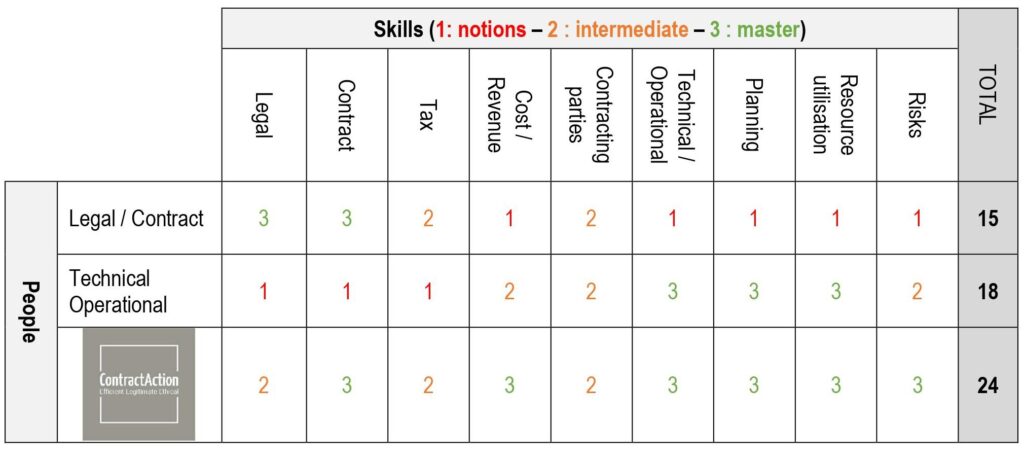
- Keep your lawyers and Operational /Technical personnel focused on their business and let ContractAction handle your Claims and communicate with counterparts about Claims background and negotiations.
Advantages
- Easier buy-in from Client
- Higher financial outcome
- Shorter Claim lifecycle
- Enhanced Claim robustness
- Fosters Client relationship
The working scheme is the following:
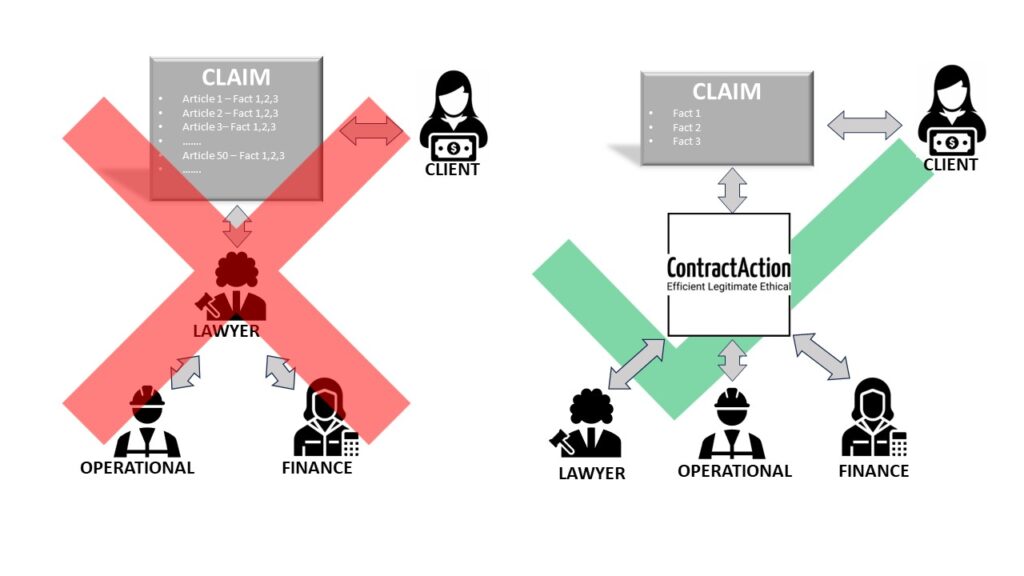
Do not wait to contact ContractAction to work out together the optimal integration within your teams